Beat the Heat: Why Hydration Matters in the UK (and How to Master It)

By Osteo & Therapy Hub — Chislehurst & Sidcup

During UK heatwaves, hydration becomes essential for preventing headaches, muscle cramps and fatigue. At Osteo & Therapy Hub in Chislehurst & Sidcup, we regularly see how dehydration affects muscle function, recovery and overall wellbeing. When the weather heats up — especially on those humid British days — your body has to work harder to stay cool.

This guide walks you through simple, practical ways to stay hydrated, spot dehydration early and look after yourself when temperatures rise.

Why Hydration Matters in UK Heatwaves

Humidity in the UK makes it harder for sweat to evaporate, meaning your body has to work twice as hard to regulate temperature. This speeds up dehydration — even if you don’t feel particularly hot.

According to the NHS, thirst is a late sign of dehydration, so it’s important to drink regularly throughout the day.

Dehydration Warning Signs to Watch For

Keep an eye out for:

  • Dark, strong‑smelling urine (aim for pale straw)

  • Tiredness, dizziness or mild confusion

  • Dry mouth or lips

  • Lingering headaches

  • Muscle cramps in the arms, legs or stomach

These symptoms are common in hot weather and often improve quickly with proper hydration.
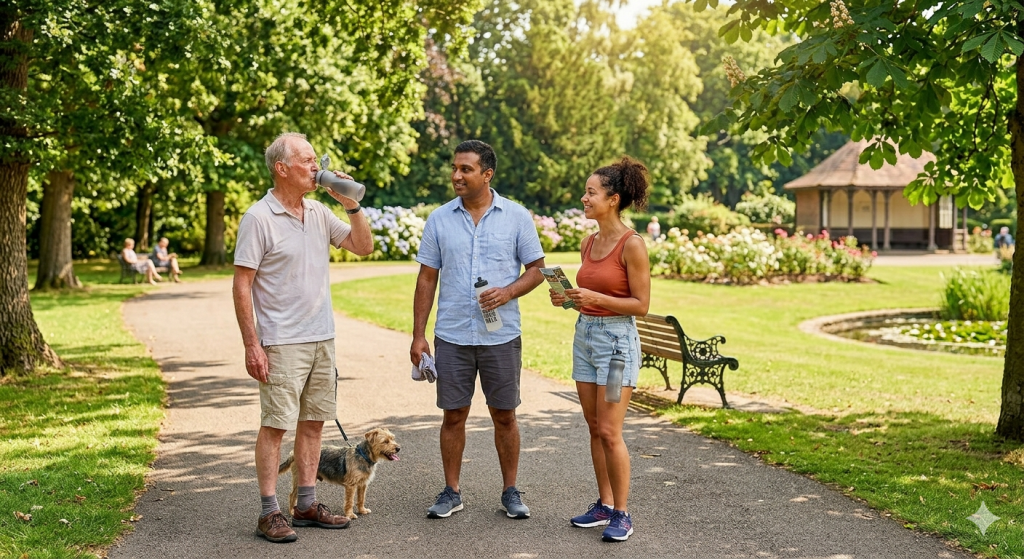
3 people hydrating in a park

Smart Ways to Stay Hydrated in Hot Weather

1. The “Little and Often” Rule

Your body can only absorb water at a certain rate (roughly 200ml to 250 ml every 20 minutes). If you down a massive amount of water all at once, most of it will just pass straight through you without properly hydrating your cells. Keep a reusable bottle next to you and take a few sips every 15 minutes.

2. Eat Your Water

Did you know that about 20% of our daily water intake typically comes from food? Add these water rich items 

  • Watermelon and strawberries: Over 90% water.
  • Cucumbers, celery, and tomatoes
  • Chilled soups like gazpacho 

3. Dress Up Your Water

If you find plain water boring, flavour it naturally

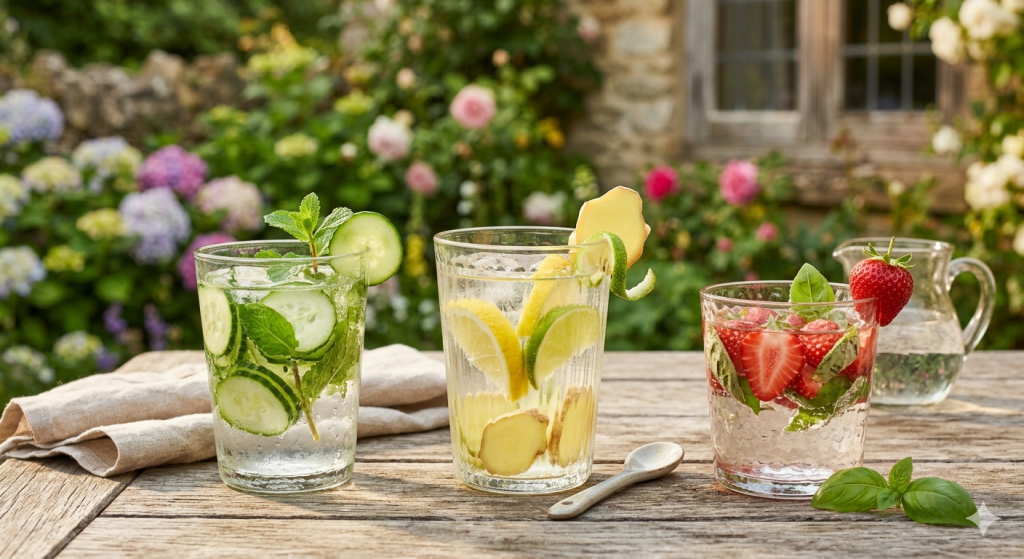
  • Cucumber and fresh mint
  • Lemon, lime, and ginger
  • Strawberries and basil

Refreshing, hydrating and perfect for British summer days.

4. Replace Your Electrolytes

When you sweat, you lose essential minerals like sodium, potassium, and magnesium. If you are drinking lots of pure water without replacing these salts, you can accidentally dilute your body’s chemistry, leading to cramping and fatigue.

  • Add a dash of high-quality squash to your water.
  • Mix a rehydration sachet or electrolyte tablet into one of your bottles.
  • Coconut water (in moderation)

5. Front-Load Your Hydration

 Mornings are generally cooler, making it much easier to comfortably drink a large glass or two of water. Start your day with 1-2 glasses of water, before coffee or breakfast. 
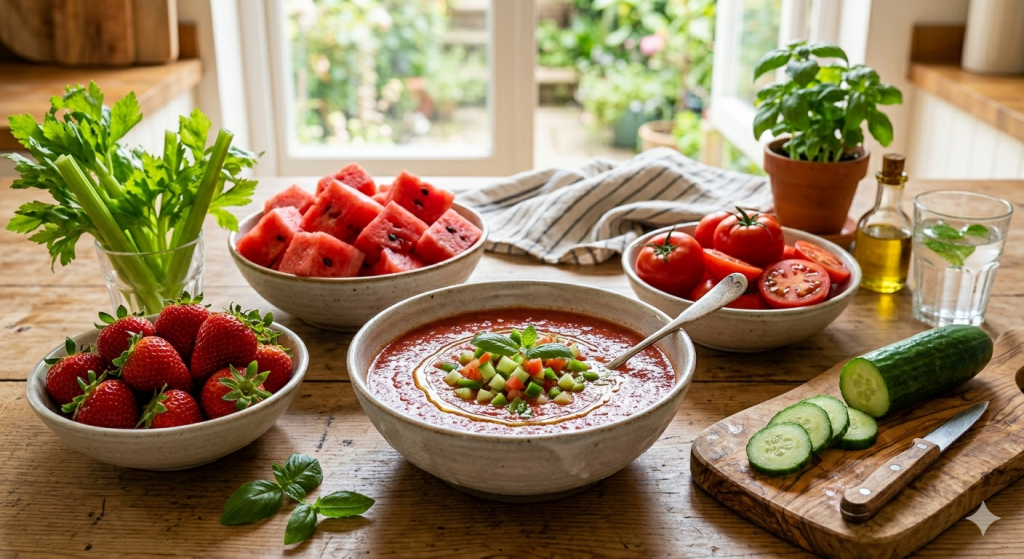
cucumber tomatoes water melon strawberries gazpacho to help hydration
Add to water, Cucumber and fresh mint or Lemon, lime, and ginger or Strawberries and basil

Hydration Mistakes to Avoid

Alcohol and heavy caffeine act as diuretics meaning they make you lose water faster.

Use the 1:1 rule: for every alcoholic or caffeinated drink you have, match it with a full glass of water.

Hydration FAQs

Q: How much water should I drink during a UK heatwave?

6-8 glasses (1.5-2 litre) of fluid a day. Fluid includes water, tea, coffee, milk, squash, juices, and even hydrating foods like fruit and vegetables — not just plain water.

Q: What colour should my urine be if I’m hydrated? 

Think pale straw. Dark yellow means you need to top up. 

Q: Are electrolyte drinks necessary in hot weather?
Not normally, however they may help if  you’re sweating a lot, exercising, or working outdoors. Otherwise, water is enough.

Q: Does coffee dehydrate you?

No — this is a common myth. Coffee and tea still count towards your daily fluid intake. Caffeine has a mild diuretic effect, but not enough to cause dehydration in normal amounts

Q: What are the early signs of dehydration according to the NHS?

Thirst, darker urine, tiredness, dizziness, dry mouth, headaches, or cramps.

How to Avoid Dehydration

  • Sip water regularly

  • Eat hydrating foods

  • Balance alcohol/caffeine with water

  • Keep an eye on vulnerable people (children, older adults, outdoor workers)


The Bottom Line

Staying safe during an English heatwave isn’t just about shade and fans — it’s about actively managing your hydration. By drinking steadily, eating water‑rich foods and recognising early signs of dehydration, you can enjoy the sunshine without the side effects.

If you’d like personalised guidance, our Nutritional Therapist Louise can help you optimise hydration and nutrition. For aches, pains or heat‑related muscle tension, Jackie — your local osteopath in Chislehurst & Sidcupis here to help.

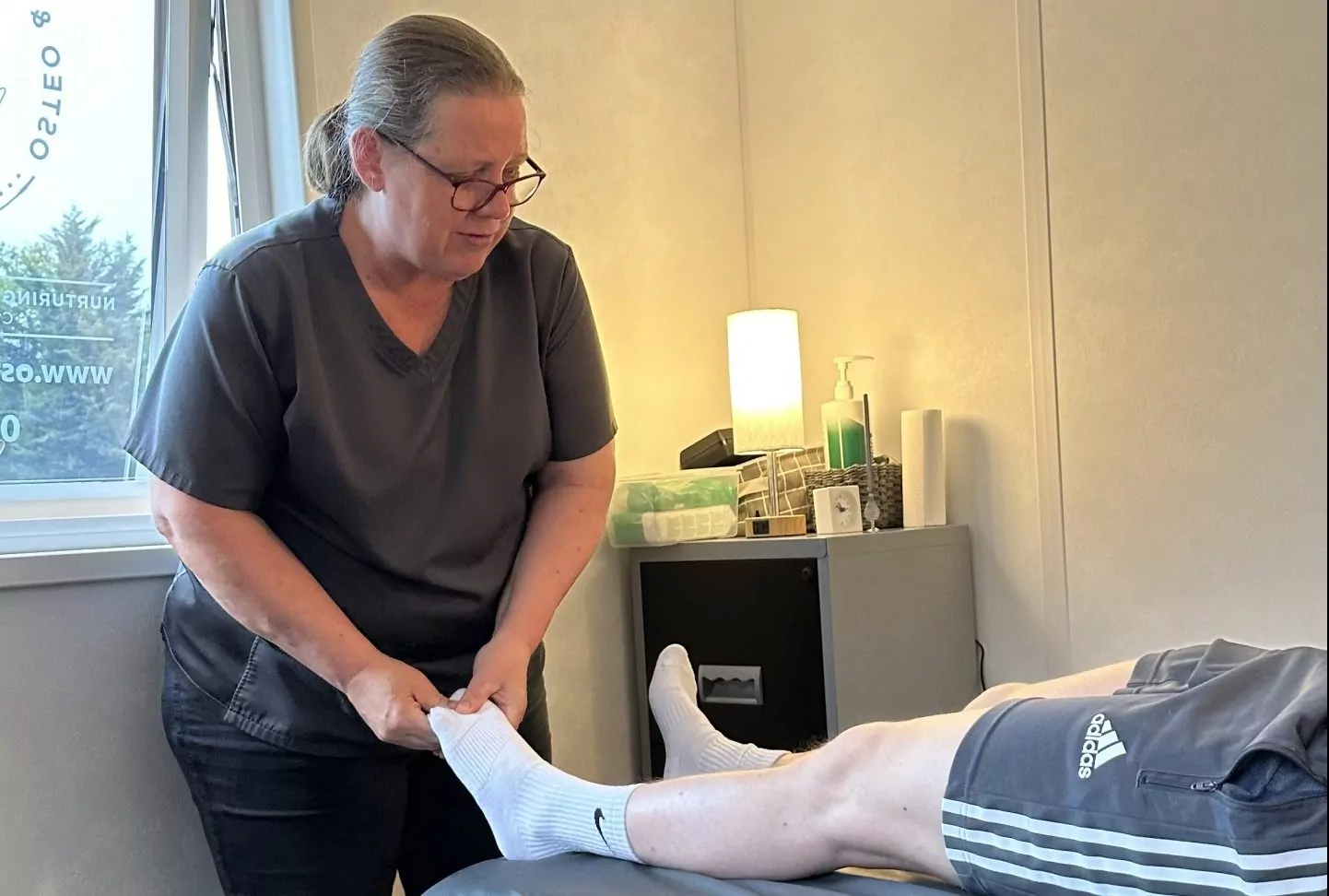
Osteopath treating seasonal foot pain

Seasonal Foot Pain

Foot Pain

Seasonal foot pain often occurs as we move from heavier footware which is less flexible, but more supportive to lighter more flexible but less supportive footware.  Have you recently changed from your winter boots, work shoes or heavy walking boots, to lighter trainers, summer shoes, or even flip flops? How are your feet feeling? Mine have been aching as they are not used to the lack of support.

Our winter boots and shoes support and restrict the movement of the joints in our feet more than our summer shoes. Summer sandals lack a lot of the material structure that comes with weatherproof footwear, whilst trainers tend to be made from softer material which does not support as well as leather etc. As a result, as we shift between restrictive to more relaxed footwear and back again, the soft tissues in our feet, such as ligaments and muscles can fatigue, become inflamed, or even strain as they try to adjust to either an increased need to stabilise your feet, or a restriction in movement.

If foot pain is ignored it can become chronic pain resulting in conditions such as plantar fasciitis. Therefore it is important to address foot pain quickly. Here are some tips for you to consider, and some exercises to try. 

Barefoot Shoes For Foot Pain.

For some people barefoot shoes help them to overcome this seasonal foot pain. These are designed to mimic the way in which your feet would work if you were walking or running without shoes on.  This helps to build strength and stability in the feet, and increases the sensory connection with the ground. 

If you fancy trying barefoot shoes you should look for shoes which have 

  • A wide toe box – this helps improve balance and stability as it allows your toes to spread naturally. 
  • Zero-drop foot bed – this ensures that the heel and forefoot are the same difference from the ground so that you maintain a more natural foot position. 
  • Flexible sole – a thin sole which flexes and bends with your feet as you move, increasing the sensory feedback from the ground and allowing a more natural foot movement. 
  • No arch support – this encourages the small muscles of your feet to work to mobilies and support the joints in your feet. 

If you do decide to try out barefoot shoes, please remember to go slowly, your feet need time to adjust, so start off with wearing new shoes for 30 minutes a day and gradually build up as the muscles strengthen. 

Exercises for Foot Pain .

I thought I would share a few of my favourite exercises to help stretch your feet out, and to reduce any aches and pains caused by a change in footwear. 

Alphabets

These are great as they can be done anytime you are sitting down. Take your shoes off and spread your toes. Imagine you are holding a pen between your big toes and second toe. 

Lift your foot off of the floor and draw the letters of the alphabet starting with a. 

Make sure you work smoothly and steadily through the alphabet. 

Repeat 1 with each foot twice a day. 

Toes Curls 

Sitting with your feet out in front of you – you may find this easier sitting on a bed or the floor. 

Point your feet and curl your toes. Hold for 5-10 seconds. 

You should feel a stretch across the top of your toes and your feet and possibly up into the front of your ankles. 

This will help the mobility of your toes. 

Hold for 5-10 secs Repeat 3-5 times 

Toe Extensions

Sitting on a chair, bed or the floor, with your legs out in front of you. 

Reverse the toe curl so that your toes are lifting upwards towards you. 

Hold for 5-10 secs and repeat 3-5 times. 

Toe Waves

Place your feet on the floor and imagine that your toes are people in a stadium doing a mexican wave. 

Try to lift each toe independently and then the next and the next until you have a sequential rhythmic movement. 

3 sets x 6 repetitions. 

Spikey Massage Ball for the Plantar Fascia

This is the soft tissue under the foot, which can become quite irritated. 

Start by sitting in a chair, once you are used to this you can move to standing so you can exert more pressure. 

Place a spikey ball under your feet, and roll the ball up and down your foot between the heel and toes. 

Try to focus on the arch and ball of the foot as you may find it irritates your heel pain. 

30 secs – 1 minute for each foot.

How Osteopathy can help with Foot Pain

After a discussion about your pain and a full examination. Using osteopathic techniques an osteopath will ensure that all the joints in your feet, ankles, and further up your body are working, and that the soft tissues such as the plantar fascia, muscles and ligaments are loosened and stretched. If you need help with your foot pain please book an appointment with your osteopath. 

family laughing

Laughter is the best medicine

Laugh more for your health

“Laughter is a bodily exercise, precious to health.” – Aristotle

We all need to laugh more for our mental and physical health.  The constant flow of negative news stories,  social media posts and miserable weather affects everyone’s mood. We all know that if our mood is low we can feel lethargic and aches and pains become more apparent. Once you start to feel pain then it in turn can affect your mental health and a vicious circle can start.

The physiological benefits of laughter

When you laugh there are several healthy physiological changes.

  • Your tolerance to pain increases.
    • Laughter increases your tolerance to pain by increasing the pain threshold.
  • When you laugh you stretch and relax your muscles
    • have you ever had the belly ache associated with roaring with laughter for several minutes? That occurs when you have given your diaphragm and abdominal muscles a really good work out – similar to doing a gym class.
  • Your blood circulation improves.
    • Laughter helps increase the oxygen in your blood and stimulates circulation reducing blood pressure.
  • You increase your oxygen intake.
    • As you laugh you will draw in a larger volume of oxygen, which can help increase your lung capacity.

The psychological benefits of laughter

Laughter also improves your mental health as it

  • Laughter releases endorphins and serotonin, neurotransmitters used in the mood control centre of your brain, which improve your sense of well-being and energy levels.
  • It reduces the stress hormone cortisol, reducing (and reversing) your stress response.
  • It improves memory and creative thinking processes.
  • Laughter is contagious and encouraging others to laugh will help prolong your laughter.

How to build laughter into your life.

For most of us a good belly laugh occurs in the presence of others – laughing at stories or jokes, a funny mishap, or the kids’ silly antics.

With younger children it is easy to get drawn in to their joy. Just watch them play, they have the most infectious giggles, tickle, chase, and dance with them. Get school age children to tell you silly jokes – they will often get them wrong cue more laughter. It won’t be long before you are all giggling helplessly and your stomachs will begin to ache.

If you have older kids it may be harder (especially if you need to separate them from their tech).  Set them a challenge, get them to think up things make you laugh. Join in with their interests that make them happy or watch films or online video clips that they think are funny. Are they up for playing to unexpected pranks (nothing dangerous or damaging!)? Try some of the current dance challenges with them. Anything to get them out of their rooms and laughing.

With friends and family, ensure you are in a relaxed welcoming space and enjoy time together. Cook and share a meal together, rehash funny memories or stories, or play some silly games such as Speak Out, charades or Pictionary.

How can osteopathy help?

The more you laugh the easier it will become, and if you find yourself with sore stomach muscles, your osteopath will be able to show you how to stretch them out. Make sure you tell your osteopath you need to laugh more, they may have a great source of silly stories or jokes to keep you entertained during your appointment, and they will want you to relax and will be happy to encourage you to laugh.

If you are looking for a more inventive way you could try laughter yoga.

If you need some help with those aches and pain so you can laugh more then please contact us to see how we can help.